
A very special trek – Part 1
It had been a while since I wanted to climb to the top of the mountain on which I built my house. My house is located in a village overlooking the Tirthan Valley, somewhere in the Indian Himalayas. The Tirthan is one of the three major rivers in a mountain range that was declared a national park in 2000. Nature can exist and enjoy life without roads, cities, factories and other human inventions. Here, we take national parks very seriously which is encouraging.
On the occasion of Diwali, a Hindu festival that could be compared to Christmas, the villagers organize a mini pilgrimage to the top of our mountain called Lambri, each year. It is with great enthusiasm that I accept their proposal to accompany them.
The mountain is at an altitude of 3600 meters above sea level and as the trek requires a night in the forest in November, I ask them what I must bring as material and food. They say, ‘A blanket to sleep and cookies to eat’. The other two meals will be cooked on the journey.
Forty people gather in the morning in the centre of the village. There are people from all age groups. The youngest is a year-old baby. He must go for his first haircut; it is considered a good omen to use the scissors at the Skirn temple, on the way to Lambri. There are older ones, whose age I could not say and I think nobody would dare send such elderly for a trek at 3600m.
My friends here are not rich, they wear plastic shoes and other sneakers that are often torn. We divide into small groups and I am a part of the group that will enjoy the company of two sheep.
I do not really understand the organization yet. But I can see that many carry a variety of utensils for cooking. Nobody went to Decathlon. The trekking equipment is from home. You just need to know how to wear it! The schoolbag of a kid serves as a backpack on which we hang pans, cans and other shopping bags. It’s less aerodynamic than a beautiful high-tech bag, but who said my villagers were suffering from consumerism?
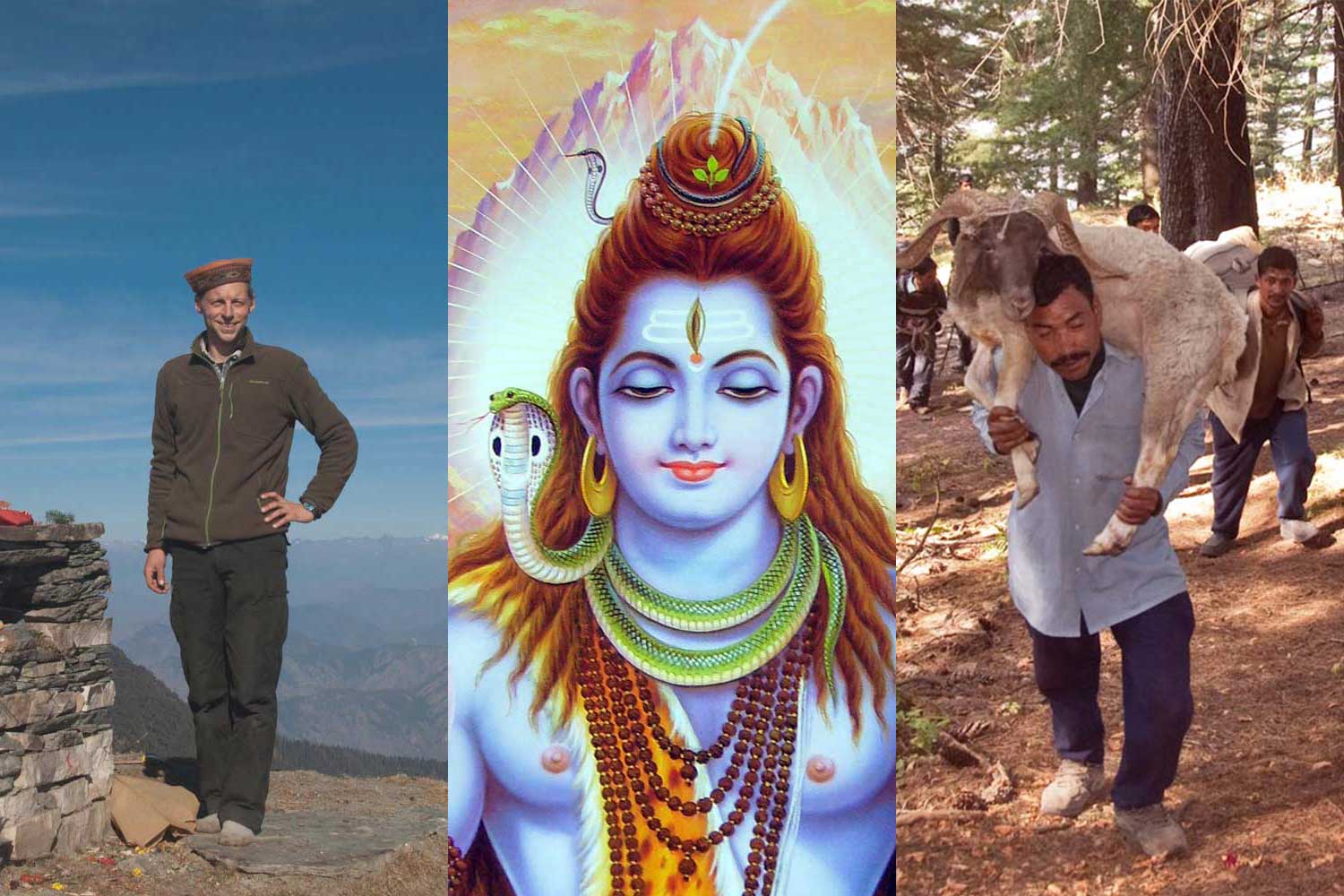
The pace of walking is fairly steady and breaks are widely spaced. It is rather the desire for a bidi (Indian cigarette rolled in a natural leaf) that grows to a standstill, than lack of breath. On the other hand, one of the sheep is too old for such a trip. He trembles on his legs and does not want to move forward. My neighbor gives his bag to someone else and grabs the sheep to put him on his shoulders. Now, it will go from one pair of shoulders to another till the destination.
Even though the sheep are killed for meals, they are loved and respected by the villagers. They know the plants the sheep like and some from the group go on to harvest enough to offer them a good snack, especially as the vegetation changes with altitude, we will not find these plants after two or three hours of walking.
After walking through a forest, through sustained effort yet happy, we finally arrive at the first and last real break of the day. « Chanan Thach », Thach means « flat and clear place » in the local language, a cool place for a bivouac. It is also the only point for water on the road. With no worries, we fill the cans, then light a fire to make the Chai (milk tea) and warm some parathas (unfermented bread filled with ingredients of your choice). My GPS displays 3100m. Only 300m of altitude remains to reach Skirn and its small temple where we will spend the night. Having started at 2000m altitude, I am surprised that the only break of the day is so close to the goal.
The climb is steep. The trail is not made to make it easier for the trekker. It goes through the dense forest and rises at the full gradient of the slope. It begins to get colder, the ground is frozen and the leaves crack under our steps. We arrive in Skirn towards the end of the afternoon. We can finally see the beautiful snow-capped peaks of the National Park while sitting under the sun.
We start a general « puja », a prayer of sorts. Each one advances towards the centre of the temple where a God rests in the form of a statuette to receive flowers and other small offerings.
The atmosphere created by the moment of prayer, the tortuous branches of the trees suffering from the altitude, the orange rays of the sun penetrating the temple, the incense’s fragrance from all the corners, multicoloured flowers around the sacred statuette, the face of the old priest with a long beard, and the silhouette of the snow-capped peaks taking on the colours of the sunset, is perfect for transporting everyone into an ecstatic state.
Once the puja is over, everyone is busy preparing dinner for the night. One of the sheep is brought to the temple for the sacrifice. A new prayer is performed to offer the life of the sheep to the god. Two men hold the sheep tight, another grabs the large billhook and strikes a dozen times at the nape of the sheep, until the head comes off.
Hot, steaming blood flows from the body and head. A smile of satisfaction is printed on the faces of men. Once emptied of blood, the head is placed in the temple near the god. Strangely, the look of the dead sheep is peaceful and benevolent, as if the God of the temple had left the statuette and settled in his eyes that remain open. This is quite different from what I had seen in the churches growing up with the Host and the wine during the mass.
The bags are emptied of their contents and the ingredients of the meal appear. No, we will not eat freeze-dried food. Everything is carried to make a festive meal, Indian meal obviously. Everyone is busy with a task. Old people cut vegetables, young girls bring firewood, a group of women are already busy cooking chapatis (Indian flat bread) on a large metal plate, others unroll bidi to collect tobacco, and mix charas (marijuana) with it to make joints.
The cannabis plant, here, is a half-wild, half-cultivated plant whose uses are numerous.
Of course, it is consumed in different ways for its psychotropic effects. We make hashish that we smoke, use the leaves for pakora (vegetable fritters), prepare a chutney (spicy sauce) with the seeds, etc. I even saw people rolling around in the bushes while devouring its leaves and flowers.
When it’s the season for harvesting hashish, everyone starts to work, including children and old people.
It’s quite easy! Just walk around, stop when you find a plant of cannabis, enclose the floral parts between the palms of the hand and roll them delicately. Under the pressure, the resin escapes from the plant, sticks on the palms and accumulates little by little.
After an hour of work, the palms are completely brown with a thin layer of resin. Then you just have to press the two palms tightly against each other by swiveling them. The resin is detached and recovered to make a small ball … of hashish. The fiber of the plant is also used to make ropes, shoes, baskets, bags, etc.
Going up to Skirn and Lambri is considered a real encounter with the local deities and alcohol is forbidden. I had even been warned to avoid alcohol for 24 hours before departure if I wanted something from the Gods. However, there is no restriction on hashish. Shiva himself is believed to be a Bhangi, a bhang smoker, a cannabis smoker.
It must be known that the Hindu Gods are often extraordinary characters and are believed to have existed. Lambri is right in front of a mountain named Shrikhand Mahadev and represents, by its slender form, the masculine attributes of Shiva. Smoking a joint in front of Shrikhand Mahadev is almost a tribute to Shiva. He is one of the three gods of the Hindu trinity, the destroyer. The other two are Brahma – the creator, and Vishnu – the protector or the stabilizer.
In the West, we consider that God indeed is a creator, but that he is only good, and therefore, his creation is good too. This is probably why we are surprised that there are wars, thieves and other sides of the coin. But what does God do?
To understand the misfortunes of the world, we must then introduce another concept, that of the devil, the evil one. On one side is God – the good, full of love, and on the other the Devil – the bad and full of hatred. This creates a polarized, Manichean worldview.
Hindu mythology and the philosophy that emanates from it, are inspired by what can be observed in nature. The cosmos is governed by forces that are invisible, but that can be felt and interpreted from natural phenomena. Each of these forces are like a character that takes the form of a God. The Hindu pantheon is therefore composed of hundreds and thousands of Gods. It would be wrong, however, to consider Hinduism as a polytheistic religion. They are not Gods as we hear God. God is unique, but he has infinite forms, he is actually present in every element of the cosmos, he is unity in diversity.
The three main forces – the creative, the destructive and the protective – are therefore a part of God and make it possible to understand the world without having to go through the concepts of good and evil.
Let’s try the Hindu method. What can we observe in nature?
Despite the 3400 meters of altitude, Skirn is an extremely rich natural site. Lichens, mosses, grasses, bushes, trees, insects, mammals and especially birds meet there in an incredible diversity! Each of these beings possesses life but come in different forms. Knowing that it all probably started with the appearance of a primitive cell some three billion years ago, I find it difficult to imagine how nature has arrived at such complexity. I wonder: but what is she looking for? Because apparently, it is quite easily akin to a search.
Nature is constantly dividing, diversifying and becoming more complex. It is as if she is constantly creating paths to explore. Each individual in nature, including you and me, is a path that seeks, experiences this tragicomic world, and conveys answers to nature. There must be a reason for this search. What is she looking for? Tricky question, I tell myself. My gaze turns to the priest who had taken up a position of meditation in front of the setting sun. He looks like he lives life like a cat resting on a heater in the winter. This makes me think that nature seeks a form of bliss, a fully conscious bliss. Could this be the ultimate goal of this research? I do not know. I only try to guess the secrets of life by observing nature. This is how we see correctly, a Hindu sage once told me.
To open a new path, you need a moment of creation, a birth. For revival to emerge, it takes a moment of destruction, a death. And between the two, the existence has to be rich enough in terms of experience, it needs certain stability, It is necessary to protect the individual and social environments for processes, experiments and developments to occur.
The three forces act permanently at every level of existence. Have you ever had a sense of shame thinking about the behavior you have had in the past? « Phew, » you said to yourself, « I’m not like that anymore. » This period of you was destroyed, you have created a new person, better in your eyes. You have been able to do it, and you realize it, because the environment in which you live in has been sufficiently stable.
The destruction and death, so dark, sad and incomprehensible in our Western culture, are essential aspects of life in Eastern cultures. It is not something bad in itself, it is a necessity in relation to the objectives of nature.
During the meal preparations, as a special guest, I am excluded from the activities. I decide to take photos. The colours and faces are truly beautiful and a delight to watch!
As the night falls, I have nothing to do and it does not take long to freeze. I empty my bag of all the warm clothes and crouch down near one of the three fires, like everyone else. I spend a good part of the night this way. The front side of my body is burning with the radiation of bright fire, the back receives the icy wind. The meal is ready, we eat on paper plates in the light of the fires.
It is here that I would have written to you that I went to sleep and that I will tell you the continuation tomorrow morning. But, I have not slept all night, so I still have plenty of stories from the night to tell.
A very special trek – Part 2
While I sit enjoying the night pass, I am asked to join a group of smokers. The joint is passed around in the circle, each smoker drawing twice or thrice, after joining and raising both hands to their foreheads in devotion, uttering phrases in honour of deities. As I notice this, the joint reaches me and I resist as I do not smoke up. Though I have been around many smoker friends who have offered me the same, I never felt the urge.
The villagers gently coax me to hold the joint, to honour our holy trip. My pleas of decline fall on no ears. I see that my group has started insisting now. I think it’s best not to ruin the blissful mood of the crowd and say, ‘Hare Rama, Hare Krishna’, before dragging my share.
I quickly feel the blessing of Rama and Krishna in the form of an intoxication that has nothing to do with that of alcohol.
From your biology class, you may remember that a nerve impulse is an electrical phenomenon. In fact, it is electric when it scours the nerve. But when the impulse passes from one nerve to another, between two synapses, it is no longer an electrical transmission, but a chemical one. A substance is produced to communicate information between two nerves.
Cannabis, once in human blood, has the particularity of influencing the chemistry between two synapses, so that the nerve impulse during transmission at synapses is slowed down. Before becoming a conscious manifestation, thoughts navigate through the brain’s nervous system. Smoking cannabis, therefore, has a direct consequence on the way of thinking.
Having become unable to understand the conversation in Hindi because of my drunkenness (and that of others), I discreetly leave the group and decide to prepare my sleeping ground. I choose a flat space away from the festivities. I get into my sleeping bag without taking off a garment, because the temperature has fallen well below zero degrees and the icy wind brazenly crosses all my layers.
I lie down comfortably on my back to observe the ceiling of the room, an immense starry sky and the canopy of hundred-year-old trees that sit on at Skirn, stand out. At this altitude, without the lights of cities and roads, the light of the weakest stars becomes visible. The corners of the sky that usually appear empty and opaque, are filled with thousands of brilliant stars whose immensity and remoteness are hard to imagine. At the same time, the darkness of the interstellar spaces becomes denser, deeper. Like a pixelated image whose definition is increased, new details appear, the contrast increases and it creates a feeling of depth and relief. In such a celestial landscape, the constellations vanish in the clouds of stars, I do not recognize anything, I lose myself in the universe, I dream with my eyes open.
To the magic of heaven, the magic of bhang has been added. I literally hover. My body is light, I don’t really feel the cold, in fact, I feel nothing, everything in me rests.
Suddenly, a very special phenomenon occurs in my mind .
I think back to the events of my day, but the effect of cannabis makes me rethink in a much more severe way about myself. In the different scenes that pass in my mind, I see myself from the outside. I analyze my behaviors and my relationships with others with much less intervention from my ego. As a result, my own interests, which usually guide my thoughts, words and deeds, are almost worthless in my judgment. This analysis of myself brings me a deep sense of shame. I cannot find all the excuses, egocentrism goes out and I realize that I’m just a selfish beast. I realize how much others have had to suffer because of my character.
I want to cry and I do. I cry without tears, the inner pain is deep. My ego sees this moment as an unbearable torture. Despite this suffering that makes me dizzy, I feel like there is another force in me, much more serene, attractive, and that seems ready to forgive everything.
Will I be plagued by schizophrenia? On the one hand, there is this selfish beast that seems to be the essence of my being in normal times. On the other hand, something much deeper, purer that exists is revealed. It is a part of me that is completely selfless, who sees right, who is full of love, but who, in everyday life, is so buried in the strata of my ego that I very rarely realize its presence. Gradually, my ego is forced to admit its misery, it releases its grip on my thought process. Finally, it capitulates and dies. The field is free, I no longer think, my soul opens, it’s as if I meet the divine. This is what some authors have called the numen experience.
It is then a real moment of magic. My conscience is finally quiet. It does not think anymore, it sees. It sees the phenomena with astonishing clairvoyance. There is no longer the rational logic you would have in the state of awakening, in the material world.
What happened to the mind? I have my little explanation.
At the origin, a thought is an impulse coming from the deepest parts of our soul, in intimate connection with the universal vital principle – the thing that animates the universe. This impulse appears on the inner surface of our brain like a bubble of air coming out of the water surface, and its contents are recovered by the brain’s nervous system.
Throughout our lives, the nervous connections of our brain are organized and re-organized according to our education, our experiences, our relationships, our behaviors. This arrangement draws the schema of our character. It is, in a way, a technical record of our ego, and is constantly evolving. The original thought is channeled by our nervous system which transforms it, blurs it, divides it, makes it travel through multiple paths. Our nervous system gives the original impulse, the colors of our character, until it becomes a stream of much more selfish thoughts, of which we become aware and which will dictate our words, our motives, and give impetus necessary for our actions.
Suddenly, a crack of a branch makes me return to the world of reality. I tell myself, it must be some animal prowling. Almost unconsciously, my mind lists the animals that inhabit the forests in the region. Gulp!
The thought of four of them makes me shudder: the cobra, the brown bear, the black bear and the leopard. I also realize that I slept quite away from the group, exactly where we all had our meal. A leopard attracted to the smell of the sheep meat waste could very well ambush me in the vicinity.
The effect of cannabis prevents me from thinking anything else, the idea of the leopard ready to jump on me obsesses me. I carefully go out of my sleeping bag and join my group of smokers. They sit around a big bed of embers. The other villagers are clustered around the fire. In fact, no one seems to sleep. It is too cold to be away from the fire. In front of the lights, the heat is too strong and the smoke turns making no position comfortable.
My cannabis smokers have the best place. The embers diffuse a very pleasant heat and do not emit smoke. Slowly, they cover with a layer of ash, which reduces the radiation. At regular intervals, one of the smokers has a stick and churns the ember to bring out the glowing parts. His eyes, the slight smile of a bhangi, his transparent inner tranquility and the sweetness of his gestures make him look like a magician who lights the ground with a magic wand.
I want to go to bed, I go back to one of the fires where the second sheep sleeps. His fur is thick. Discreetly, I sit next to him. I slowly go closer and lie down near the fire with my head in his fur. He does not flinch. I feel a sense of pity as, tomorrow, he will be killed.
The night continues but I never close my eyes the whole time.
A very special trek – Part 3
I do not know if I should rejoice, the first glimmers of the sun appear above the Himalayan peaks. The sun will warm us up. I could finally take a nap, but this morning, I’m not supposed to sleep. I have to go to Lambri.
Having not slept, I do not have the energy to resume a walk in the mountains. Besides, not everyone goes to Lambri. A good part will stay back in Skirn to prepare the second meal. But I told everyone I’ll go to the top. Well, I think it will be for the next time.
The only baby in the group is brought to the temple where the priest is waiting with a huge pair of scissors usually used to cut sheep’s wool. It’s a ritual that I did not really understand. It is only done for boys. At the age of one, the first haircut must be performed in a temple, and that of Skirn apparently fits the purpose well.
The baby is sitting on the sheep and the priest is trying to cut his hair. But the child’s fine hair can not be sliced by scissors that only know the thick woolen hair of sheeps. I hand over my Swiss penknife that will do the trick.
I enjoy waṭching the Golden oaks glisten with the rays of the rising. The first group leaves for Lambri. With a twinge in my heart, I watch them go. I stick to my decision and say to myself, that one must be reasonable, especially because it is necessary to go down again to the village on the same day. The second group starts. I reconsider the question. I weigh the pros and cons. The counter wins again.
I confirm to everyone that I am too tired to go. I feel a little cowardly, but I accept it. The third group, apparently the last, starts. When the last figure disappears behind a big tree, I shout to Om, my neighbor in the village, that I will go to Lambri, and I run to join the last group.
I run out of breath quickly and wonder what could have happened in my mind… I realize that it is out of pride that suddenly I decided to leave, to show everyone that I too can get there. My ego is back in force after its nocturnal torture.
The muscles are warming up, the breath is stabilizing, I feel happy to go there. It’s strange, the closer I get to the top, the more energy I feel, that makes me forget the fatigue. I always feel the same in the mountains, approaching a summit. As if they were places of concentration of some kind of natural energy. I am sure that here the Professor Calculus’ pendulum would dance the French Cancan.
The forest fades away and gives way to beautiful brownish pastures that open up a grassy path to the summit. Ten minutes from the goal, the villagers stop and take off their shoes. They wave at me to do the same and explain that the summit of Lambri is a place connected with a Mataji – a local goddess. Lambri is therefore considered to be a temple, and it is customary to remove one’s shoes before entering the realm of the summit.
We finally arrive at the top, barefoot. Being in direct contact with the ground is magical. I feel full of energy. I live a real ecstasy. The view is beautiful, you can clearly see all the frozen peaks of the Great Himalayan National Park. We have fun identifying all the massifs and points of reference. The Kinnaur Massif, the Shimla Hills, the Dhauladhar Massif where the Dalai Lama took refuge, the desert regions of Lahaul & Spiti, and distant peaks near the Tibetan plateau.
In this moment, I thank the impulse of pride that took over me and got me here.
It’s strange, that night I realized how much my ego made me a poor, bad-charactered fool. I realized that this material world, the world of the individual, the world of the ego is only an illusion and that the true nature of things, almost imperceptible, is everywhere, in everything, full of love and forgiveness. I felt a divine force in me, a vital principle which binds us all and which animates us. When I realized this, I perceived my ego as the one that spoiled everything, the one that polluted my thoughts, my words and my actions by making them selfish, self-interested and narcissistic.
But now, I know that without my ego, nothing happens. Thanks to the vanity of my ego, I saw an extraordinary moment at the top of Lambri.
Last night, I was to die of shame, and this morning, I’m proud to live. Now, I want to live differently. The intimate connection I have with my soul tranquilizes my mind, gives me confidence. It’s like a little voice telling me, « Do not worry, I’m with you to do beautiful things ». I feel my soul inside me …
To annihilate my ego is a means of establishing a communication with my deeper soul, but without it, I would not exist, I would lose my identity and I would no longer be able to fulfill the mission entrusted to me.
What makes me say that we are in charge of a mission?
The opposition between the ego and the soul as I live it, exists also between nature and the universal soul (call it God, if you may). How we live as an individual is only a miniature form of what is happening on the cosmic scale.
You just need to observe nature carefully to realize that she pursues a goal. It’s been 15 billion years since nature has been changing, evolving. Unceasingly, she becomes more complex, diversifies and spreads. From the hydrogen atom, she created the DNA. From the simplest unicellular organism, she has spawned mammals. From the smallest grain of sand, she extends into billions of stars. She uses the energy of the cosmos to make forests populated by millions of plant and animal species. You may find the argument a little weak, but … it is inconceivable to me to think that she does all this aimlessly.
Nature seeks, explores. And to do it, she creates individuals. You, me, and everything that ultimately has an identity. We all participate in this research. We are all in charge of a mission. Individuality and ego (centrism) are necessary in relation to the objectives of nature. The connection with our soul, and hence the universal soul, is necessary to understand what our mission is, our reason for being.
I feel so good here in the sun at the top of Lambri, contemplating in the Himalayas. Lambri has offered me many answers to existential questions. But I have one left. How do we manage our ego so it does not make us selfish beasts leading lives without a reason to be? Mataji Lambri answered this question for me.
We must get our ego out of bad habits. It is in our soul that our ego will find good inspirations. We must therefore try, by every possible means, to facilitate the communication between our soul and our ego. In this way, our ego can gradually educate itself, transforming its character so that it brings us spontaneously, unconsciously on a fertile and meaningful existential path. I would not advise the use of cannabis to make it happen. Prayer, meditation, introspection and walks in nature are effective ways to communicate with our soul.
At the top of Lambri, some stones had been gathered to serve as a sanctuary for this sacred place. We deposit the few flowers collected on the way. I am told that everyone must make a wish. The puja is a celebration of the Mataji. If she hears our prayers, she will come down to fulfill our wishes.
We finish the puja, take pictures, smoke bidi and chat quietly. Suddenly, a woman screams. It looks like she has been possessed by Mataji. We must leave immediately. We run down the slope to where we left our shoes. As I write this article, I realise that my wish is coming true.
The return to Skirn goes smoothly. The second sheep has been sacrificed, the meal is almost ready. I decide to eat vegetarian food because after sleeping on the sheep, I do not have the heart to eat his meat.
After the meal, everyone packs their bags and prepares to return to the village. I decide to leave early because the descent would be laborious. I set off with one of my neighbors. I walk slower than him and tell him he can go at his own pace, I remember the way to Chanan Thatch. He flies and disappears before me.
Trekking down painfully with my aching legs, it looks like I am lost on an old path crossing the forest that leads nowhere.
Gulp …
I do not want to believe that I am lost, and I do not want to go back either. At first, confidently, I decide to continue going down. I try to recognize the topography, but it does not correspond to what I remember from the climb.
The path has now completely disappeared. I do not know what to do. I do not have the strength to go up or go down as it does not lead to any place that I know, and if I try to get to the left or right, it will only make the situation worse. I sit down to think. The idea of losing myself in this mountain forest does not please me at all. However, I am forced to accept the situation, I am well and truly lost. I call for help, no one answers. Certainly, this mountain has made me live a lot of experiences …
I think back about the leopards and other dangerous beasts. It really would not be good luck, but here alone in the forest, I am at the mercy of the first one to pass by. I do not wish to die, neither this way nor today … I do not know why, but I take the time to think about it, lost in this forest. The events of last night make me think that dying will not be the end. I know that my soul will not die, that it will only leave my body. I understand death better. It makes me less afraid because I know it will be a moment of encounter with pure love.
To better understand death is also to better understand life.
Why did the primitive soul choose to embark on the adventure of life? She probably had to be at peace. Maybe too much.
She did not know herself. To be conscious of oneself, one must at least be two. If I never meet anyone, if there is no other, I would not have a name, I would not know who I am. Therefore, if enjoying is an experience that is shared, how would one truly experience it if they never met anyone or never had a name. It would be impossible.
To know herself, she had to divide. But we do not divide energy. It was first necessary to transform this energy into matter. Thus, the primitive soul has returned to the material world of phenomena, to the sphere of experience.
For billions of years, she has been dividing, meeting, getting to know others. When two people meet, it is the universal soul that meets the other universal soul, it is God who meets God.
Life is the choice of the universal soul, to forget everything, to relearn everything. The choice to rewrite a story, to go back to the ultimate truth, the ultimate bliss. It’s a bit like when we have to experience a moment of suffering to rediscover true well-being. It’s a bit like forgetting something and then remembering it.
When we are bored, we often think of playing a game. Sometimes risky games, which will bring us perhaps misfortunes. We do not want misfortunes, but when they come, we know that after the rain, comes the good weather. And in that good weather, we will enjoy more than today, because we would have gone through a phase of suffering.
The universal soul also wants to play. And her playground is nature, it’s us.
This is in fact what the story of Genesis tells us through the story of Adam and Eve. For the primitive soul (Eve), the temptation was too great, she had to taste the apple. It is the fall of Eve into the world of phenomena, sufferings and pleasures.
Finally, I decide to go down. At worst, I can not find my village, but I will eventually arrive at the Tirthan River that I know well and is bordered by a road.
Through the bushes, and tall forests, I tumble down the slope falling continuously. From time to time, I would call for help, crying out in the hope that someone would hear me. Luckily, I find one of the groups.
What a relief! I was ready to run 2000 meters of difference in altitude across everything to avoid spending the night alone in the forest.
We reached the village after three hours of descent.
What a pleasure it is to arrive home at the end of a beautiful hike!
Rethinking, I understand why a temple stands at Skirn and a shrine at Lambri. I have lived so many adventures of the spirit. Special forces surely exist there!
 Stephan Marchal