
Methodology for development aid within indigenous rural communities
Understanding how development works in tribal villages (see the post “What is development?”), I found a way to intervene for development aid. I converted it into a methodology that makes development a self-chosen path and that reduces the side-effects of development aid to the minimum.
The methodology involves 4 steps that combine each other in a virtuous circle ultimately leading to endigenous development. Click on the image below to enlarge it. It is a diagram that shows how the 4 steps are interconnected. It is in the name of SWAPAN, an organization that I founded with wonderful people in Jharkhand.
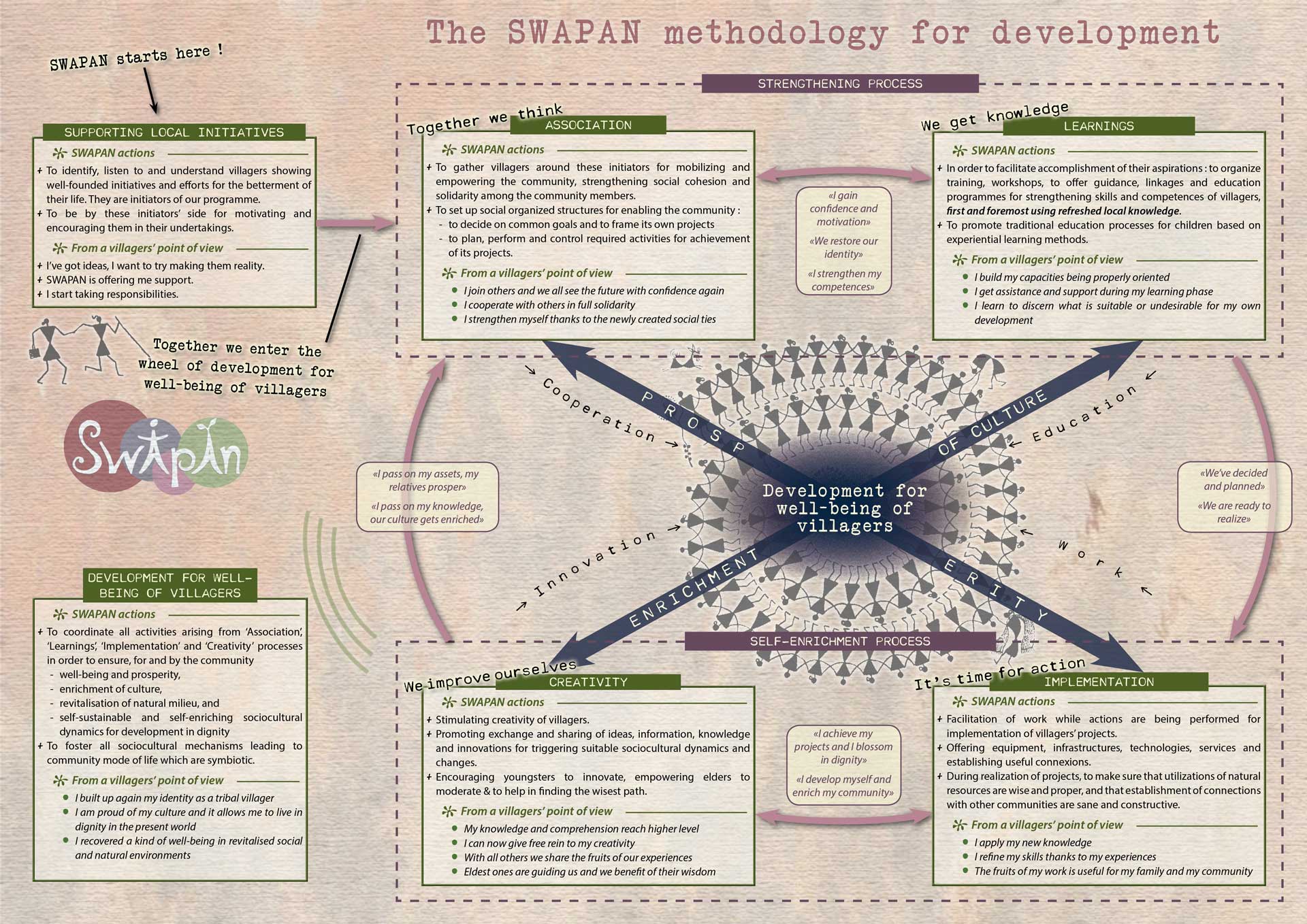
Here is how it works :
It starts with the initiative of the villagers.
Most individuals from underprivileged and marginalized communities in rural areas show characteristic symptoms of poverty, that are lack of confidence, self-esteem and decision-making capacity, associated with deep despondency.
Among these villagers, some show initiatives to go ahead and undertake. I call them “Initiators”. Most of the time, these “Initiators” are unable to find proper environments for giving concrete shape to their aspirations. Therefore, they either move out of the village in search of a job, draining the human capital from their native place, or they join extremist movements or become alcoholics, etc. Making the situation even worst !
The first step of development aid should be to identify and establish a relationship with these “Initiators”. Through discussions and surveys, their culture, awareness level, their inner goals, and the barriers they are facing have to be understood. Simply become their benevolent friend.
It spreads itself with the ‘Association’ step.
Before starting up any venture with the “initiators”, it is an absolute necessity to overcome the mental condition resulting from poverty. Courage and confidence must come first, and they should come from the closer social environments : family, friends and neighbours.
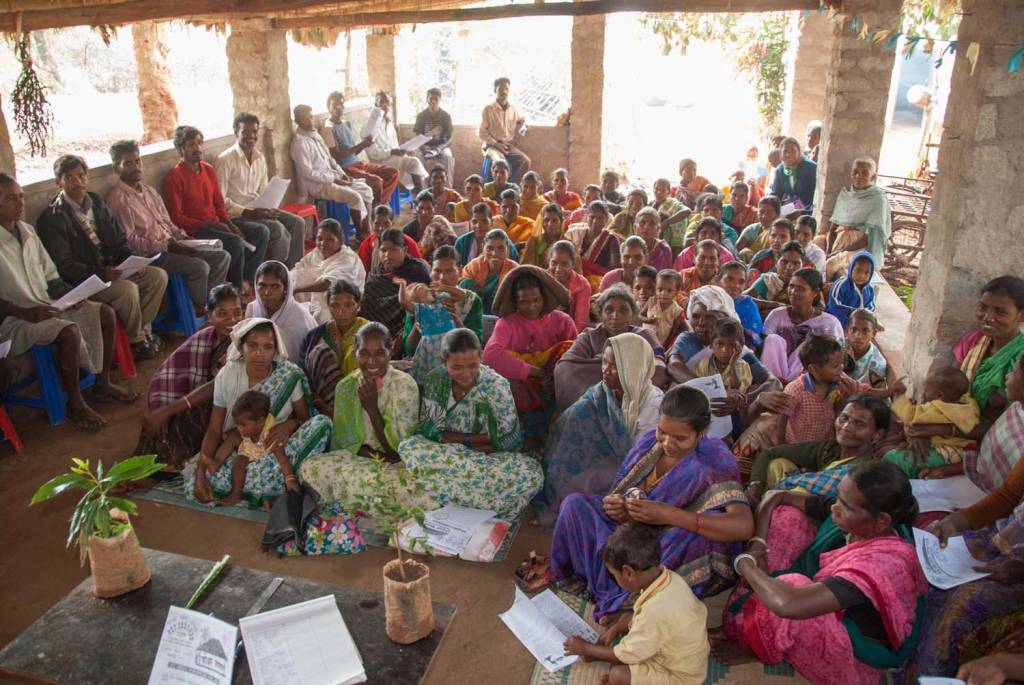
The ‘Association’ step suggests the “Initiators” to invite their socially closest villagers to form groups of a dozen of persons. In this way, the first “Initiators” pass on their motivation/ideas to others. The groups create conducive social environments for self-assurance, solidarity and collective working. Afterwards, all the groups of a culturally homogeneous area can be gathered together to form a larger entity. This « federation » of the groups is the perfect place for reviving the sense of community and for forging the community objectives in the given context.
A system for facilitating communication and decision making has to be gradually devised with the villagers.
Capacities are built at the ‘Learning’ step.
With the social strengthening and empowerment comes the ‘Learning’ step. The groups and community projects having been shaped, villagers have to get ready to implement them. The local know-how, which can be refined if required, has to be utilized first. Let the villagers share their knowledge and ideas. If some knowledge is felt missing, it can be brought by the development aid agency in the form of training and learning methods that can be replicated by the villagers themselves.
Keep in mind that any project should be preferably implemented with fewer machines, and with renewable energy.
Furthermore, a mechanism has to be arranged to allow the ‘Learning’ phase to be continuously enriched thanks to the inputs of the ‘Creativity’ step.
‘Association’ and ‘Learning’ steps together promote a ‘Strengthening process’ which allows villagers to enter …
… the ‘Implementation’ step.
Villagers have expressed their aspirations, they have decided and have planned together, they have built their capacities. They now are ready to convert their dreams into concrete actions. At this step, the development aid agent should facilitate their work, bringing missing equipment, infrastructures and facilitating linkages. Keeping in mind that local resources are always preferable.
It is also advised to promote a non-monetary system of exchange. A separate post will explain some ways to achieve this.
This is when the ‘Creativity’ step comes.
By implementing their projects, villagers will enter the sphere of experience where they will definitely start to innovate. A proper environment should be created to ensure all learning and innovations emerging from ‘Implementation’ step are further developed and shared with the community and the wider audience. Innovation, self-expression and dissemination can be promoted through various social and cultural activities.
These ‘Implementation’ and ‘Creativity’ steps give rise to the ‘self-enrichment process’.
The virtuous circle
When all these steps are properly conducted, it triggers a double mechanism that ultimately leads to endogenous self-sustainable development.
Villagers are associated and implement the projects they have decided together. They are “working together for prosperity”. This ensures self-sustainability and social cohesion.
Villagers are continuously brought in a learning phase, enriched by the creativity of everyone. They are “sharing their innovations for the enrichment of their culture”. This allows the development to be an endogenous process preserving an ecosystemic harmony between the villagers themselves and the natural environment.
 Stephan Marchal